



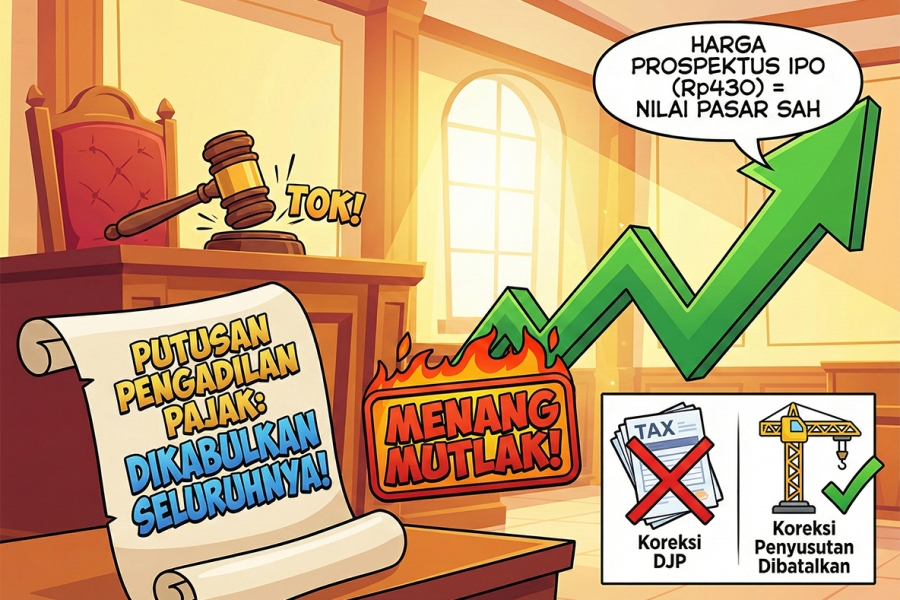
Legal certainty regarding the application of Final Income Tax (PPh) Article 4 paragraph (2) on construction services has become a crucial issue, reaffirmed by the Tax Court, where the formal legal status of the service provider is the main determinant of its tax classification, not solely the substance of the work. According to Government Regulation Number 51 of 2008, income from construction services is indeed subject to Final PPh. However, this decision highlights a discrepancy in implementation between the general provisions of the Regulation and its implementing regulations. Decision Number PUT-011953.25/2020/PP/M.IVB of 2025, which fully granted the appeal of PT ESG, annulled the Final PPh correction made by the Directorate General of Taxes (DJP) because PT ESG had fulfilled its obligation to withhold PPh Article 23 on vendors who did not possess a Business Entity Certificate (SBU).
The core conflict in this dispute originated from the DJP's correction of the Final PPh Article 4 paragraph (2) Tax Base (DPP) amounting to IDR 188,795,250.00. The DJP claimed that the entire transaction amount within the DPP constituted construction execution and applied a 4% Final PPh for non-qualified service providers as regulated in the Government Regulation on Construction Services. The DJP relied on the substance of the transaction and the availability of a Final PPh tariff for construction services without business qualifications. However, PT ESG strongly refuted this classification. PT ESG argued that payments for services were made to parties who did not have a Business Entity Certificate (SBU) from the Construction Services Development Board (LPJK). Therefore, referring to Minister of Finance Regulation (PMK) 141/PMK.03/2015, the service must be categorized as Other Services subject to non-final PPh Article 23.
In its resolution, the Tax Court Panel of Judges explicitly supported PT ESG's argument. The Panel's consideration focused on the critical importance of the service provider's legal status based on PMK 141/PMK.03/2015. If the vendor does not possess official licensing and/or certification as a construction service business, the services they provide are automatically not related to Final PPh for Construction Services and revert to being classified as non-final withholding PPh, namely PPh Article 23. The absence of the SBU serves as strong evidence that the recipient of the income is not subject to Final PPh for Construction Services. Moreover, since PT ESG was proven to have already withheld, deposited, and reported PPh Article 23 on the same object, the Panel judged that imposing Final PPh would lead to double taxation, which contradicts the principle of justice in the tax system.
The implications of this Decision are highly significant for every Taxpayer utilizing services whose activities include installation, repair, or maintenance. This decision sets a strong precedent affirming that certification formality is a material requirement in determining the correct type of PPh. The compliance strategy that Taxpayers must strictly adhere to is prioritizing vendor qualification documents. If an SBU is not available, the obligation to withhold PPh Article 23 must be applied to avoid the risk of Final PPh correction at the examination and litigation stage, which could potentially be followed by administrative sanctions. Certainty and fairness in tax withholding can only be achieved through Taxpayer diligence in classifying the legal status of the vendor and fulfilling the withholding obligation that best aligns with the applicable implementing regulations.













 tpc.consulting
  tpc.consulting
  info@taxindo.co.id